Discrete Charting Agent
Designing an AI charting agent that works the way nurses actually talk — not the way forms are structured.
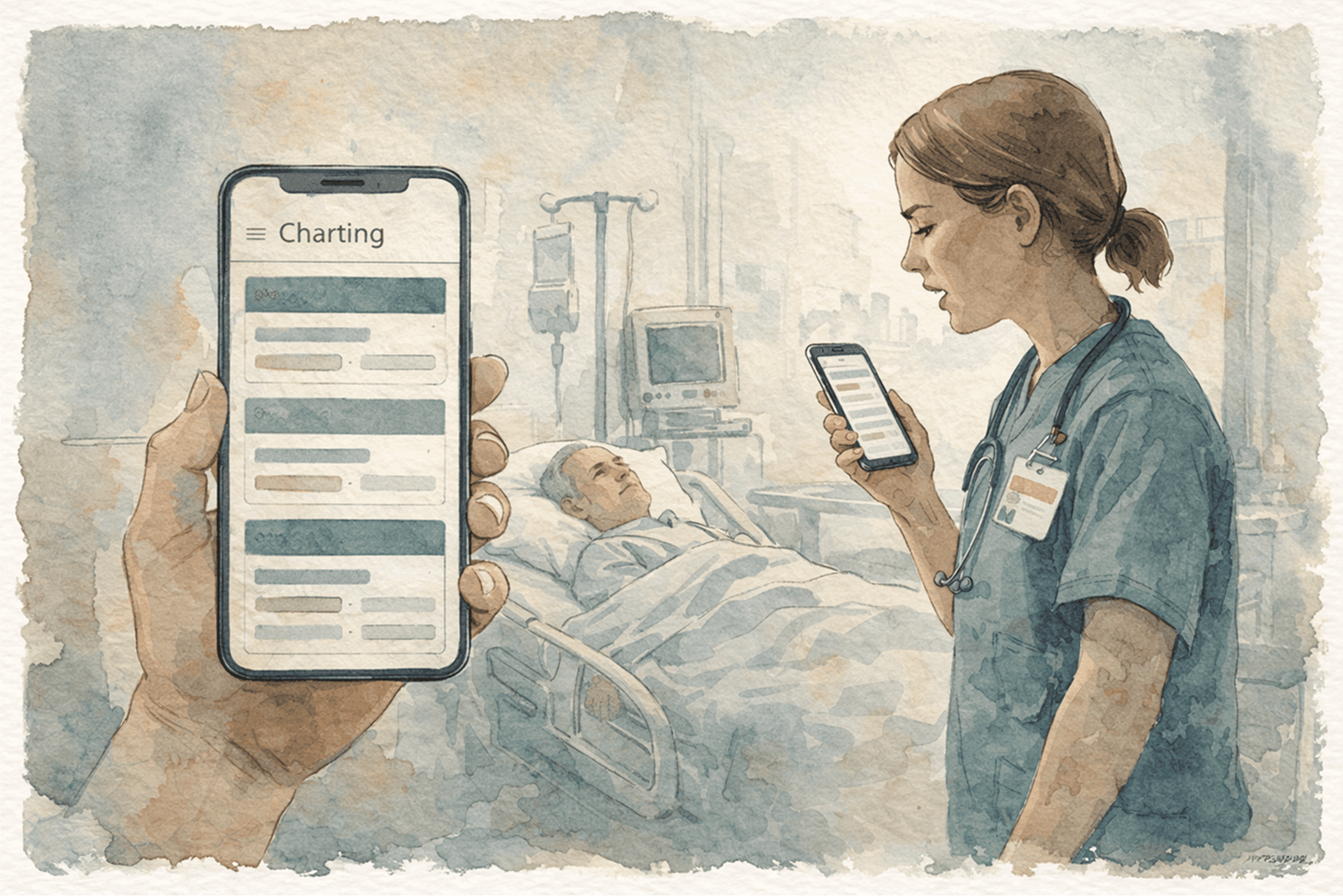
Context: Nurses in hospitals must record hundreds of individual patient observations per shift — pain scores, wound measurements, IV site condition, medication intake — into a desktop Electronic Health Record (EHR). This is called charting. It happens on a desktop, while care happens at the bedside.
Impact at a Glance
~200 users
(shift = 12 hrs a day)
29,300+
>65%
>80%
ADLs, Safety Checks, Intake & Output
The Problem
Nurses perform 70+ checks per 12-hour shift across 5-7 patients. Even recording 3-4 observations takes ~50 seconds on the desktop EHR — nurses context-switch constantly between patient and screen. Reconstructing hours of observations from memory at end of shift (back-charting) is the norm. Industry back-charting rate: 27%.
The opportunity: let nurses chart in natural language, at the bedside, on mobile.
My Role
End-to-end - Research through Beta
Cross-functional: PM, engineering, data science
Research
6 research streams:
Oracle Health Summit 2024 - nursing director presented my initial prototype; gathered live feedback
Internal nursing working group - weekly with Oracle nursing consultants
External nursing working group - bi-weekly with nurses at US & UK client sites
In-person shadowing - BayCare Health System, Tampa FL
Pilot focus group testing - weekly
Pilot release follow-up - ongoing weekly check-ins
What We Learned
The interface breaks muscle memory - clunky navigation, shifting sections, hidden fields
Real-time charting is universally valued, consistently deprioritized -patient needs always win
Back-charting is the norm - and every nurse named documentation fatigue
Reviewing beats creating - nurses wanted a head start they could verify and sign, not a blank form
The insight that shaped the interaction model
Watching a senior nurse teach a junior nurse to chart — narrating observations naturally, the way one colleague talks to another. The agent needed to fit that mental model.
The Solution
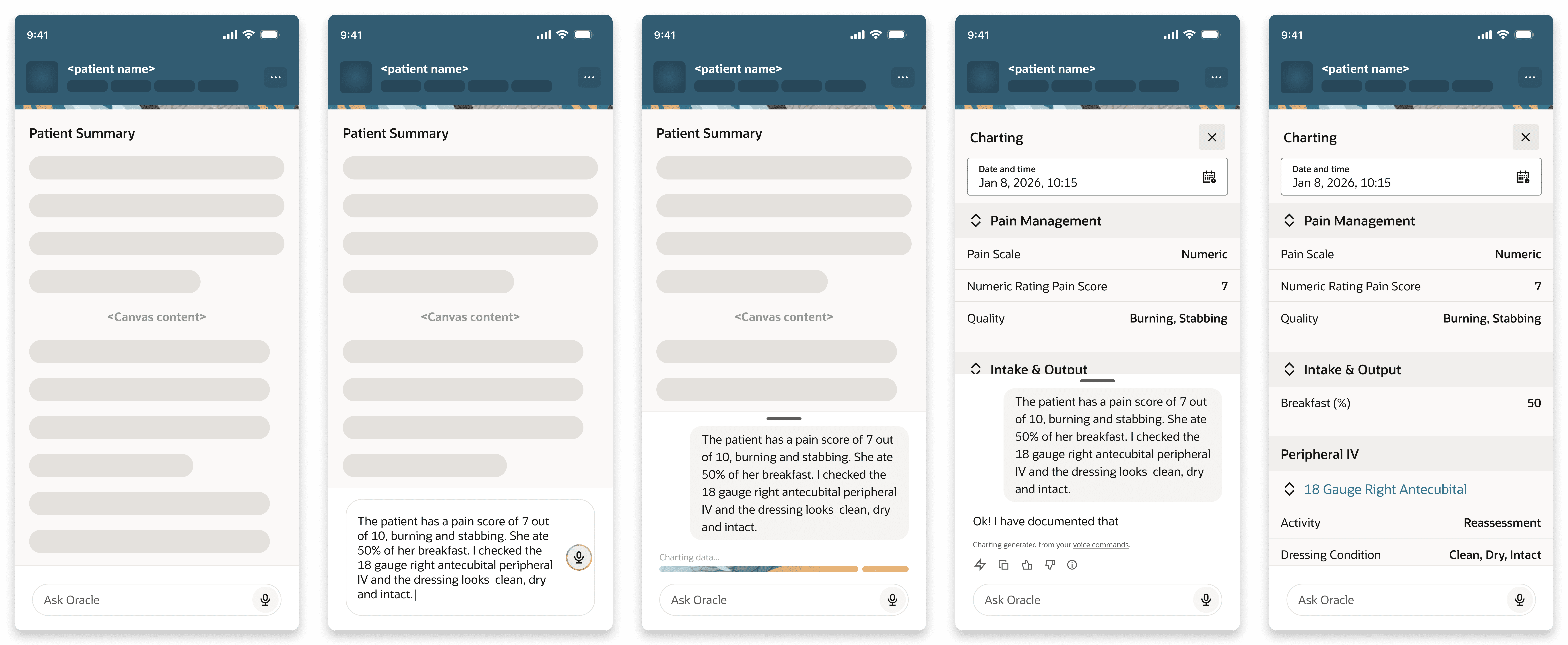
A conversation-forward mobile app where nurses speak naturally — "pain is 7, stabbing, in the abdomen" — and the AI maps their words to the right structured clinical fields automatically. The charting screen generates on the fly from what the nurse said, not from a full form loaded upfront.
Key Design Decisions
How should a nurse trigger the AI without friction?
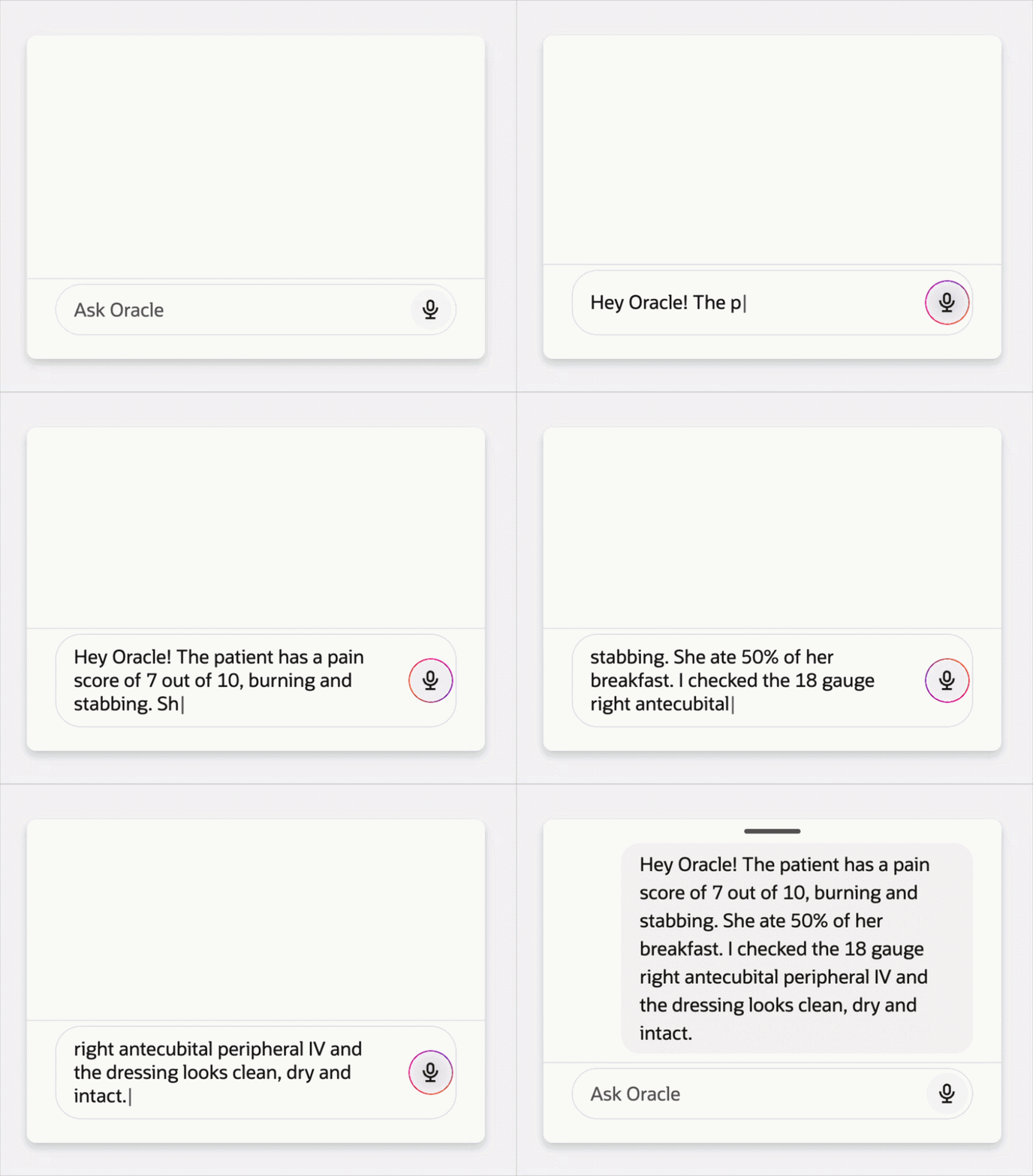
Nurses assist patients, prepare medications, wear gloves — a tap-to-send model assumes free hands that often aren't free. We chose auto-send on silence detection: the agent listens, and when the nurse pauses for 2 seconds, it processes. Critically, auto-send slot-fills — it never auto-signs. Nurses always verify charted values before committing them to the patient's record.
When a chat thread isn't the right container
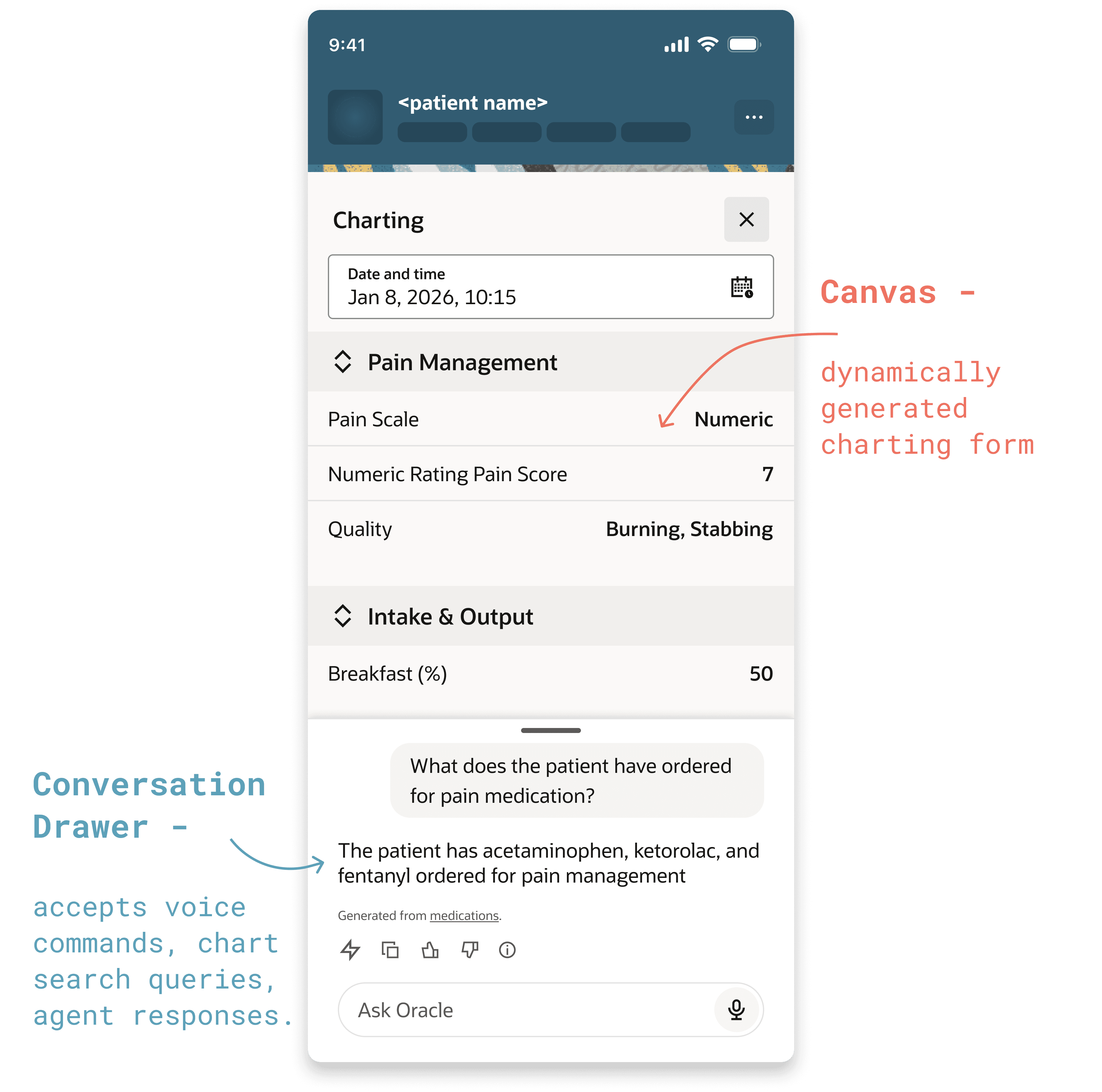
Conversation-only charting broke immediately — hundreds of individual clinical fields re-rendering with every edit created a thread too long to scan or verify. We separated the editing surface (Canvas) from the conversational input (Conversation drawer). A nurse can chart pain as 7/10, then immediately ask "what was the last documented pain for this patient?" — two different agents, one seamless experience.
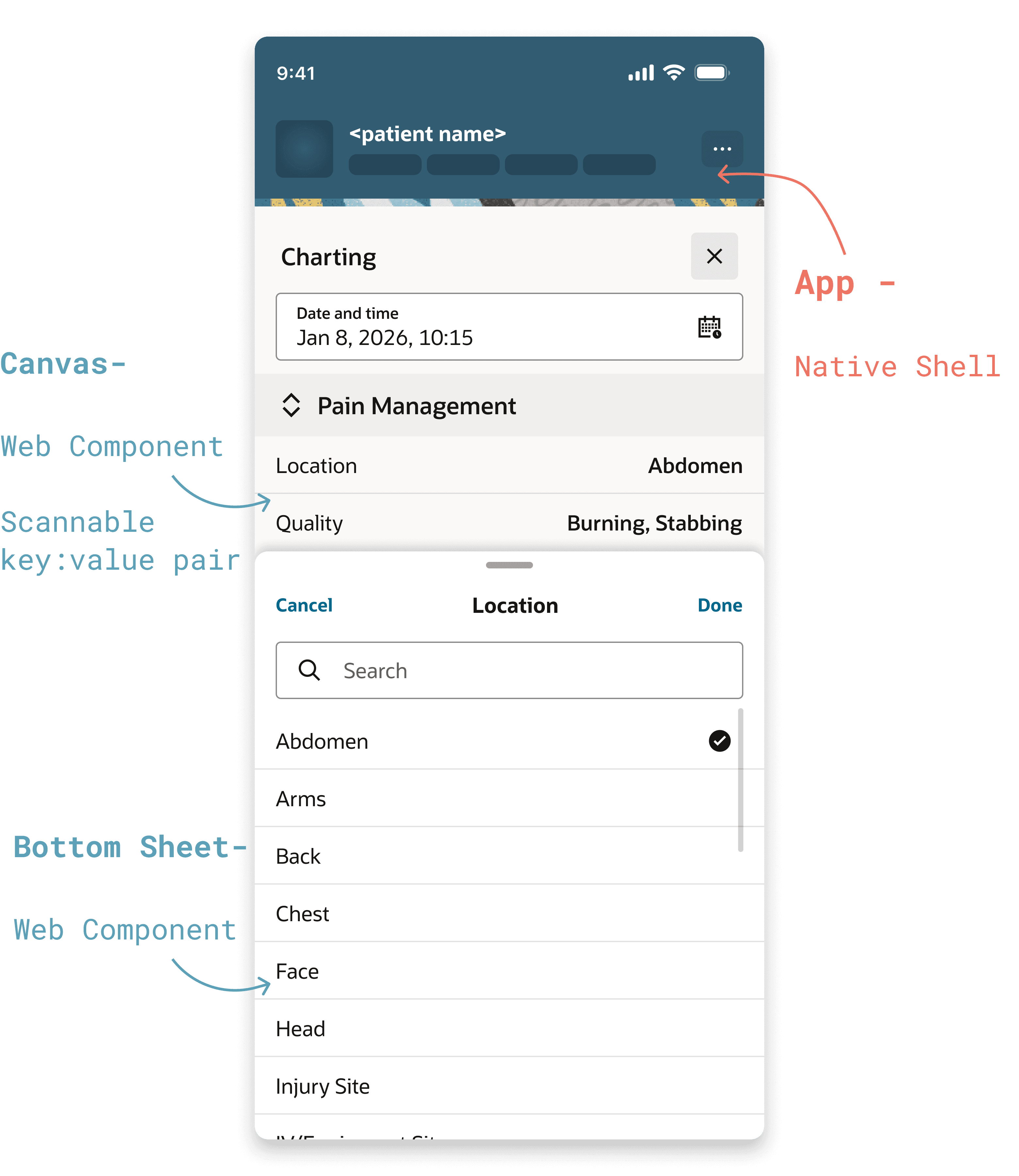
When the design system doesn't fit the medium
Impact
~200
>65%
Adoption rate among Registered Nurses (RNs)
>80%
Documentation completion rate by Patient Care Tech (PCTs)
Reflections
Designing for a system in transition The agent had to write back to Cerner Millennium today while staying compatible with the future EHRM platform. Every decision carried a dual constraint: work now, stay relevant later. That tension made me understand both systems deeply - and shaped how I think about designing for platforms mid-evolution.
From consumer to co-owner The CAAM Mobile Framework didn't have the components this product needed. Rather than waiting, I designed them. The engineering team recognized what was happening before design formally did - and invited me in. The lesson wasn't about components. It was about recognizing when the work in front of you is bigger than the project you were assigned.
What's Next
Patient Summary and Chart Search agents are in active beta evaluation at BayCare, Billings Clinic, and AtlantiCare - expanding CAAM Nursing across the clinical workflow.
Repeatable Groups, enabling charting for wounds, IVs, lines, tubes, and drains, is in active development, addressing one of the most complex disambiguation challenges in clinical documentation.